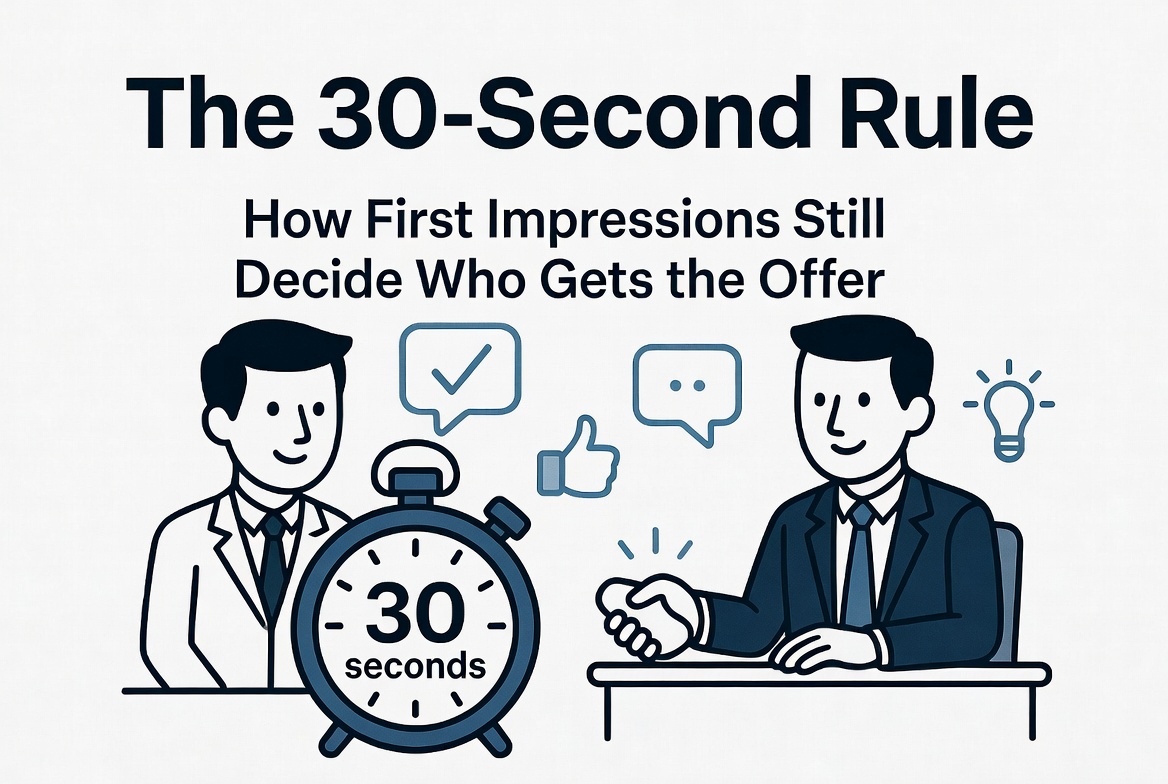
You spent three weeks tailoring your resume. You rehearsed answers to every behavioral question you could find. You researched the company's mission, memorized the interviewer's LinkedIn profile, and showed up ten minutes early in your best outfit. And yet, by the time you sat down and said hello, the outcome may have already been decided. This is the 30 second rule, and it is one of the most uncomfortable truths in hiring.
Psychological research has consistently shown that human beings form rapid, durable impressions of strangers within moments of meeting them. In an interview setting, those initial impressions do not merely set the tone. They create a cognitive framework through which every subsequent answer, gesture, and qualification is interpreted. Get the first 30 seconds right, and the interviewer spends the remaining time confirming their positive instinct. Get it wrong, and you are swimming upstream for the rest of the conversation.
What the Research Says
The science behind first impressions is well established. Research published in the American Psychological Association journals has demonstrated that people assess warmth and competence within milliseconds of visual contact. In hiring contexts, studies from the University of Toledo found that judgments made in the first 10 seconds of an interview correlated strongly with final hiring decisions, even after 30 minutes of structured questioning.
This phenomenon is driven by what psychologists call confirmation bias: once an initial impression is formed, the brain selectively processes information that supports it and discounts information that contradicts it. An interviewer who likes you in the first 30 seconds will unconsciously give you the benefit of the doubt on a mediocre answer. An interviewer who does not will hold the same answer against you.
The interview does not start when the first question is asked. It starts the moment you are seen.
This is not fair. It is not rational. And it is, according to decades of organizational psychology research, almost universal. The question is not whether the 30 second rule exists. It does. The question is what you do about it.
The Five Signals That Matter Most
First impressions in an interview are built on a small number of high impact signals. You do not need to be the most charismatic person in the room. You need to nail the fundamentals.
Punctuality and Presence
Arriving on time is the minimum. Arriving composed is what separates candidates. If you walk in flustered, out of breath, or visibly anxious, the interviewer registers that before you say a word. Give yourself a buffer. Arrive 15 minutes early, spend five minutes in the lobby collecting your thoughts, and walk into the room with calm energy. For virtual interviews, log in three minutes before the start time with your camera on, your background clean, and your lighting even.
The Handshake and Eye Contact
In person, a firm (not crushing) handshake paired with direct eye contact communicates confidence more effectively than any verbal statement. Research from the Society for Human Resource Management suggests that interviewers consistently rank handshake quality as a meaningful factor in their initial assessment of candidates. For virtual interviews, the equivalent is looking into the camera (not at the screen) during your greeting and offering a warm, unhurried hello.
Verbal Tone and Pace
The first words out of your mouth carry disproportionate weight. Speak clearly, at a moderate pace, and with genuine warmth. A rushed, monotone, or overly rehearsed greeting signals nervousness. A slow, confident opening signals composure. Something as simple as "Thank you for making the time to meet with me, I have been looking forward to this conversation" said with sincerity can anchor the entire interview on a positive foundation.
Appearance and Grooming
This is not about expensive clothing. It is about intentionality. Dressing one level above the company's daily dress code signals respect for the process. Clean, well fitting clothes in neutral or classic tones will never work against you. If you are unsure about the company culture, the EEOC provides guidance on employer dress code policies and employee rights, which can help you calibrate your expectations.
Posture and Body Language
Sit upright but relaxed. Avoid crossing your arms, fidgeting with objects, or leaning back too casually. Research consistently shows that open body posture is read as confidence and engagement, while closed posture is read as defensiveness or disinterest. A slight forward lean during the interviewer's questions signals active listening. Nod naturally, not excessively.
In 2026, a significant percentage of first round interviews are conducted over video. The 30 second rule applies with equal force, but the signals shift. Your background, lighting, camera angle, and audio quality are now part of your first impression. Invest in a ring light, position your camera at eye level, and test your setup before every call. These small details signal professionalism before you even introduce yourself.
What Happens After the First 30 Seconds
If you nail the opening, the interview becomes a conversation rather than an interrogation. Interviewers who form a positive first impression are more likely to ask follow up questions, engage in genuine dialogue, and share information about the team and culture. This creates a virtuous cycle: the more the interviewer talks, the more rapport you build, and the stronger the overall impression becomes.
If the opening goes poorly, recovery is possible but difficult. The best strategy is to redirect with a strong, specific answer to the first substantive question. Prepare a concise, compelling response to "Tell me about yourself" that highlights your most relevant achievement and connects it directly to the role. This is your reset button. Use it.
Preparation Is the Real Advantage
The candidates who consistently ace the first 30 seconds are not naturally more charming. They are more prepared. They have rehearsed their entrance. They have practiced their greeting. They have tested their technology. They know what they are going to wear, what they are going to say, and how they are going to carry themselves before they ever walk through the door.
This is where modern job search tools make a real difference. Platforms like Oh My Job use AI powered matching to connect you with roles that genuinely fit your profile, which means you spend less time applying to jobs you will never hear back from and more time preparing for the interviews that actually matter. When you are well matched to a role, your confidence in the interview room increases naturally, and that confidence is exactly what the first 30 seconds are designed to detect.
The Bottom Line
You cannot control every variable in a job interview. You cannot control the interviewer's mood, the other candidates' qualifications, or whether the company decides to freeze the position at the last minute. But you can control the first 30 seconds. And the data is clear: those 30 seconds carry more weight than most candidates realize.
Prepare for them with the same rigor you bring to your resume, your cover letter, and your technical skills. Because in the end, the offer does not go to the most qualified candidate. It goes to the most qualified candidate who also made the best first impression.